Plisio Suspends Payments After a Security Incident: What Merchants Should Do Now
08/11/2026
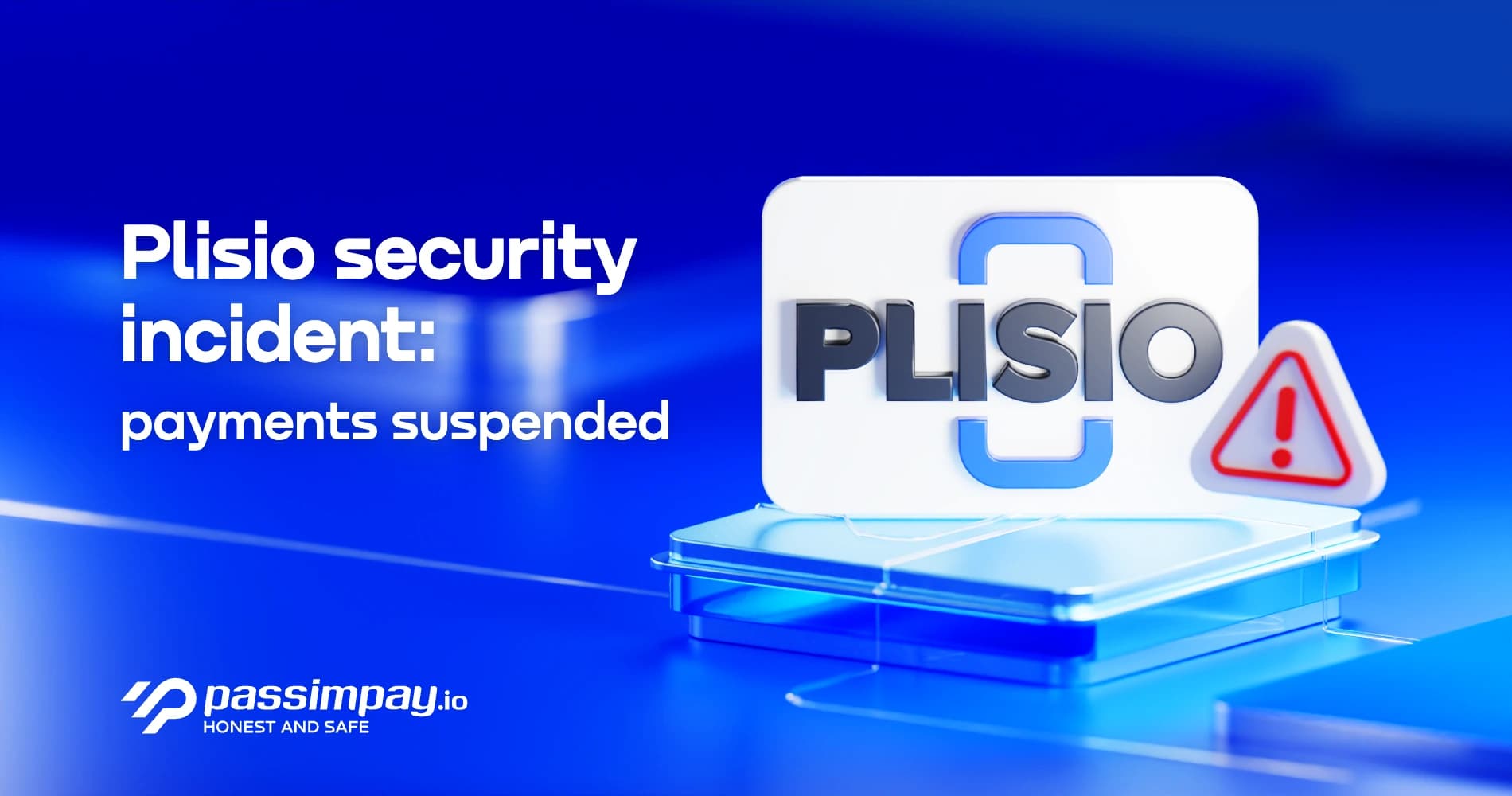
Update, 10 November 2026: plisio.net still shows the suspension notice and says work to restore the service is underway. Plisio has not published the scope of the incident, a restoration date or whether merchant balances were affected.
Crypto payment processor Plisio has temporarily suspended incoming and outgoing payments after what it describes as a security incident caused by a hacker attack. If your checkout runs on Plisio, your customers may not be able to pay right now and pending payouts may be delayed. Here is what we know, and what merchants can do today to protect revenue.
What happened
As of 11:00 UTC on November 8, 2026, the Plisio website shows a “Service Temporarily Unavailable” notice. According to the notice:
the service is experiencing a security incident caused by a hacker attack;
processing of incoming and outgoing payments has been temporarily suspended for security reasons;
work to restore the service is underway;
support is under high load, so responses may be slower than usual.
At the time of writing, Plisio has not published the scale of the incident, the affected networks or a restoration timeline, and no independent confirmation of losses has appeared. Any figure circulating on forums or social media should be treated as unverified. We will update this article if official details become available.
What it means for merchants
A payment suspension at a processor hits a business in three places at once:
Lost sales. Invoices and checkout pages that depend on the processor cannot accept new payments, so customers abandon orders.
Delayed payouts. Withdrawals and mass payouts are paused, which affects cash flow, affiliate and partner payments, and supplier settlements.
Uncertainty about balances. Until the processor confirms the scope of the incident, merchants cannot be sure when, and in what form, balances held on the platform will be available.
This is not specific to one provider. On October 29, Binance lost about $6.36 billion in the largest exchange hack recorded, according to TRM Labs. In early November, Brazilian exchange Mercado Bitcoin suspended deposits and withdrawals after a security incident of its own. BTCPay Server, a self-hosted option, issued security advisories in both August and November 2026 after hot wallets on outdated instances were drained. Custodial and self-hosted setups alike have been affected, which is why payment resilience has become an operational question and not only a security one.
Working out how to keep taking payments while your provider is offline? Talk to our team and we will help you set up a fallback checkout.
What to do now
Pause the affected checkout. Temporarily hide the payment option or display a notice, so customers do not send funds to invoices that may not be processed.
Remove old deposit addresses from circulation. Static addresses may still sit in saved invoices, email receipts and the records of repeat customers. Until the processor confirms that its wallets are safe, take those addresses out of anything a customer could pay into.
Contact customers with pending payments. Tell buyers whose payment has not been confirmed that settlement is delayed and that their order is not lost. Doing this before they open a dispute or a chargeback with their card issuer saves far more than it costs.
Reconcile orders. Compare orders marked as paid with actual on-chain receipts for the last few days and keep records for any claims.
Rotate credentials. Change your account password, enable 2FA and regenerate API keys and webhook secrets once the service is back.
Be careful with “recovery” offers. Incidents attract fake recovery services and forum threads inviting affected users to submit wallet addresses, transaction details and loss amounts. No legitimate service recovers crypto for an upfront fee, and sharing wallet data widely adds a second risk on top of the first. Use the provider’s official channels, and your own legal counsel where the sums justify it.
Follow official channels only. Incidents attract phishing: ignore “refund” or “verification” links from unknown senders and check updates directly on the provider’s website.
Add a backup gateway. Connect a second crypto processor so you can switch traffic in minutes the next time any provider goes down.
How PassimPay can help
If your current provider is offline, every hour without a working checkout means lost orders. A crypto payment gateway for business like PassimPay can be connected as your primary provider or as a backup, so you keep accepting payments while others are down.
PassimPay has processed more than $4B in crypto payments. More than 530 merchants in 122 countries use it, and it handles over 750,000 transactions a month with 99.99% uptime.
PassimPay provides 15 platform products, including 12 CMS plugins and official integration libraries published through its GitHub organization. Available integrations include:
CMS plugins: WooCommerce, Magento 2, OpenCart, PrestaShop, WHMCS, Drupal, Joomla, MODX, Shop-Script, Tilda and Bitrix
API wrappers: PHP and Python libraries for custom integration, available on GitHub
Payment invoices: hosted payment pages that need no developer setup
Static deposit addresses: a permanent address for each customer, useful for top-ups and repeat payments
Mass payouts: pay partners and suppliers in one batch from a single dashboard with Multisender
The API-first architecture is documented in the PassimPay API docs. It is built for developers who need custom checkout flows, payment confirmations via webhook and automated withdrawals.
You can accept BTC, ETH, SOL, USDT, USDC and more than 74 supported coins in total on 18+ blockchains. Incoming payments can be converted into stablecoins automatically. PassimPay is a registered MSB with FINTRAC (C100000852), AML screening of incoming payments is free, and fees start at 0.5% (see the pricing page).
Support is handled by people, not bots. Every merchant gets a personal manager who helps with the setup, answers questions in a shared chat and stays with the account afterwards.
Need a working checkout today? Contact our team, and your personal manager will help you go live quickly.
FAQ
Is Plisio down?
As of 10 November 2026, Plisio's website still shows a notice that incoming and outgoing payments are temporarily suspended after a security incident caused by a hacker attack. Check Plisio's official website for current status.
Was Plisio hacked?
Plisio states that it is experiencing a security incident caused by a hacker attack. It has not yet published details on the scale or affected networks.
Can I withdraw my funds from Plisio?
According to Plisio’s notice, outgoing payments are temporarily suspended. Follow official Plisio channels for updates on withdrawals.
What is a good Plisio alternative for accepting crypto payments?
Look for a provider with a track record, multi-coin support including USDT and USDC, ready-made CMS plugins and payouts. PassimPay covers these and can be set up as a primary or backup gateway.
Sources
Plisio service notice, archived on 8 November 2026 at 11:03 UTC: Web Archive
Plisio live page (will change once the service is restored): plisio.net
TRM Labs, North Korea Steals $6.36 Billion From Binance in the Largest Hack in History, 29 October 2026: www.trmlabs.com/resources/blog/north-korea-steals-usd-6-36-billion-from-binance-in-the-largest-hack-in-history
Crypto.news, Brazil's Mercado Bitcoin reports security incident, freezes withdrawals, November 2026: crypto.news/brazils-mercado-bitcoin-reports-security-incident-freezes-withdrawals
The Hacker News, Hackers exploit BTCPay Server flaw to drain hot wallets, November 2026: thehackernews.com/2026/11/hackers-exploit-btcpay-server-flaw-to.html
 Contact us →
Do you like this article? Share it with your friends.


More